

How moments of shared humanity reveal a peace that’s always closer than we think
Christmas has a strange relationship with conflict.
Year after year, even in the middle of war, violence, and political division, the idea of a Christmas pause keeps reappearing. Sometimes it takes the form of an official ceasefire proposal. Sometimes it appears as a symbolic gesture. And sometimes, as history reminds us, it happens spontaneously—without permission, coordination, or strategy.
These moments rarely end wars.
But they reveal something just as important:
Conflict is not as inevitable as it pretends to be.
And when it pauses—even briefly—something deeply human emerges.
The Christmas Truce of 1914: When Humanity Interrupted War
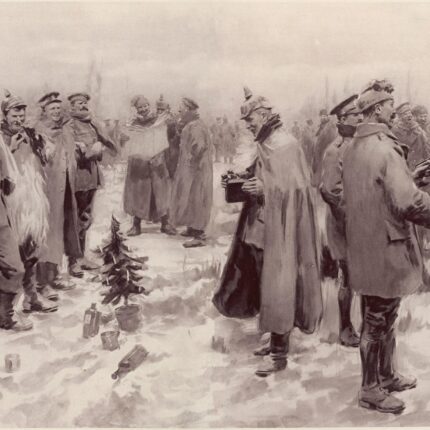
In December 1914, during the first winter of World War I, soldiers along parts of the Western Front did something extraordinary.
They stopped fighting.
British and German troops climbed out of their trenches on Christmas Day. They crossed no-man’s-land. They exchanged food, cigarettes, and small gifts. They sang carols together. In some places, they played football.
This moment—now known as the Christmas Truce—was not ordered by generals or negotiated by diplomats. In fact, it was discouraged by command on both sides.
It happened anyway.
The truce did not end the war. Fighting resumed in the following days, and the conflict would grind on for years. But for a brief window, the narrative of enemy collapsed.
What replaced it was something simpler and more honest:
Human beings recognizing one another as human beings.
Why the Christmas Truce Still Matters
It’s easy to dismiss the Christmas Truce as a sentimental anomaly—a beautiful but impractical footnote in a brutal history.
But that interpretation misses the point.
The truce matters not because it solved anything, but because it revealed something:
Even in the most extreme conditions of fear, propaganda, and identity, people can still choose connection when priorities shift.
The soldiers didn’t forget the war. They didn’t suddenly agree on politics or borders. They didn’t become naïve.
They paused.
And in that pause, the illusion that conflict was total and absolute cracked open.
Christmas and Modern Conflict: Why the Idea Keeps Returning
More than a century later, the idea of a Christmas pause continues to surface in modern wars.
In recent years, amid ongoing global conflicts—most visibly the war in Ukraine—calls for holiday ceasefires or temporary truces have repeatedly emerged around Christmas. Some are proposed by governments. Others are urged by humanitarian organizations or religious leaders.
Many of these proposals are rejected.
The reasons are usually strategic:
- fear of giving the other side an advantage,
- concern about regrouping or rearming,
- distrust of intentions.
And yet, the fact that these proposals keep appearing is itself revealing.
Even in an age of drones, cyberwarfare, and long-range missiles, the symbolic power of Christmas persists. The idea of pausing violence continues to carry moral weight—whether or not it is accepted.
Why?
Because Christmas, stripped of religion and ritual, represents something deeper than tradition.
It represents a temporary suspension of “us versus them.”
Pausing Conflict Is Not Weakness
One of the strongest illusions in both war and everyday life is the belief that stopping—even briefly—is a sign of weakness.
That illusion fuels escalation:
- in geopolitics,
- in relationships,
- in internal struggles.
But the Christmas Truce suggests the opposite.
Pausing conflict requires courage.
It requires stepping out of certainty.
It requires tolerating vulnerability.
It requires seeing the other side as something more than an obstacle.
This same dynamic — where effort, certainty, and control quietly sustain struggle — is explored more deeply in Why Control Doesn’t Bring Relief, which looks at how stopping the fight often reveals the peace we were trying to force.
This is true on battlefields—and in living rooms.
From Battlefields to Daily Life: The Same Pattern Repeats
The dynamics that govern war are not fundamentally different from the dynamics that govern everyday human conflict.
They run on the same fuel:
- identity,
- fear,
- self-protection,
- the need to be right,
- the need to win.
And just as in war, most personal conflicts don’t persist because they’re unsolvable.
They persist because no one pauses long enough to see beyond their position.
The Christmas Truce didn’t happen because soldiers negotiated better arguments. It happened because, for a moment, the urgency to defend identity loosened.
That loosening is the doorway.
Christmas as a Shift in Priority
This is why Christmas has always had such strange power.
For a brief period, many people naturally:
- soften their judgments,
- lower their defenses,
- prioritize generosity over advantage,
- value connection over outcome.
The world doesn’t suddenly become safe or simple.
But priorities change.
And when priorities change, behavior follows.
The Christmas Truce was not a miracle because it was rare.
It was a miracle because it revealed what becomes possible when fear stops running the show—even temporarily.
Selflessness, Presence, and the End of “Enemy”
At the heart of both the Christmas Truce and modern calls for holiday ceasefires is the same underlying movement:
a shift from self-centered survival to shared presence.
This is not about morality.
It’s not about virtue signaling.
It’s not about pretending conflict doesn’t exist.
It’s about recognizing that:
- identity is not the whole story,
- fear does not deserve total authority,
- and separation is not the deepest truth.
When presence replaces positioning, the concept of “enemy” begins to dissolve—not permanently, but enough to remind us it was constructed in the first place.
Why These Moments Feel So Powerful
Pauses in conflict resonate so deeply because they confront a quiet assumption most of us carry:
That hostility is more natural than peace.
The Christmas Truce proved otherwise.
It showed that violence requires constant reinforcement—orders, narratives, commands, justifications—while connection can emerge spontaneously when those reinforcements drop away.
Peace, in this sense, is not something we build.
It’s something that appears when we stop obstructing it.
The Invitation Hidden in the Christmas Truce
We often talk about peace as if it must start somewhere far away—between nations, leaders, or ideologies.
But the Christmas Truce offers a different starting point.
It begins with a pause.
A pause in:
- escalation,
- certainty,
- reaction,
- identity defense.
That pause doesn’t solve everything.
But it changes the field in which everything happens.
And that is no small thing.
What This Means Right Now
In a world saturated with conflict—internationally, socially, and personally—the idea of a Christmas pause is not naïve.
It’s instructive.
It reminds us that:
- conflict thrives on momentum,
- peace begins with interruption,
- and humanity reappears when we stop insisting on separation.
Whether on a battlefield, in political discourse, or in your own inner life, the question is the same:
Where could a pause change everything?
Something to Reflect On
- Where in your life are you fighting out of habit rather than necessity?
- What identity are you defending that might not need defending?
- What would happen if, even briefly, you laid your weapons down?
The Christmas Truce didn’t end a war.
But it revealed the possibility of peace.
And sometimes, that revelation is where everything truly begins.
The insights explored here—identity, conflict, presence, and the power of pausing—are central themes in our ongoing work.
For a deeper exploration of how awareness reshapes perception and dissolves unnecessary struggle, you can explore our book:
Proof That You’re God
https://www.amazon.com/dp/B0DKCMR183/
Peace doesn’t always arrive as an agreement.
Sometimes, it arrives as a moment where we simply stop fighting.