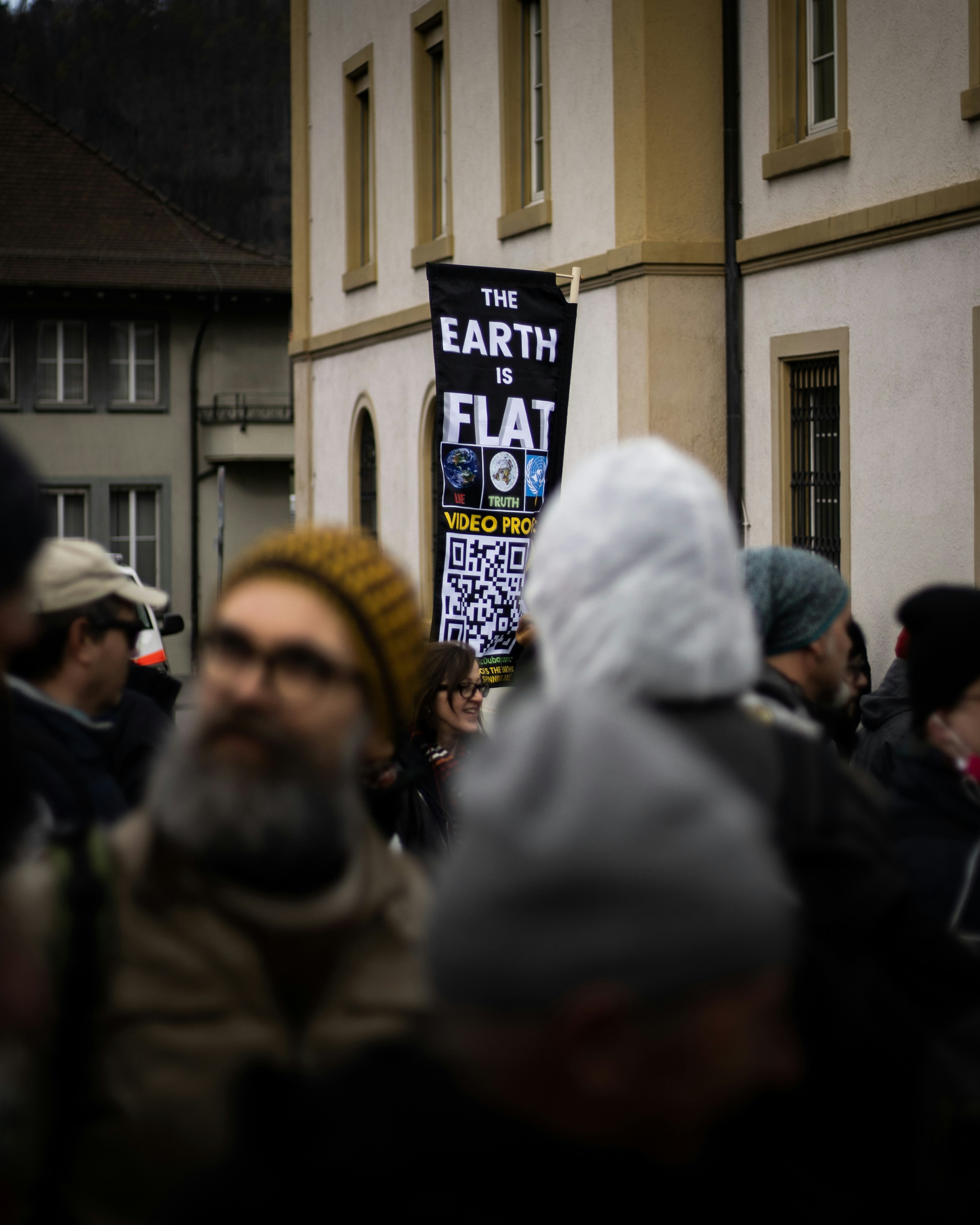
It’s tempting to treat Flat Earth belief as a failure of intelligence.
To assume it’s about misunderstanding physics, rejecting evidence, or lacking education.
But that framing misses the point entirely.
Flat Earth belief doesn’t spread because its arguments are persuasive.
It spreads because it meets psychological needs that modern culture often leaves unmet.
To understand why someone would adopt such a belief—often passionately—we need to look not at the “science” being rejected, but at the experience being reclaimed.
This pattern isn’t unique to Flat Earth communities. It appears wherever people feel overwhelmed by institutions, alienated from authority, and disoriented by a world that feels too large, too abstract, and too loud—a collective tension explored more deeply in why the world feels so loud.
Flat Earth Isn’t About the Shape of the Planet
For most believers, Flat Earth isn’t a claim—it’s a position.
A position that says:
- “I don’t trust official narratives.”
- “I won’t outsource my perception.”
- “I see through the illusion.”
- “I’m not asleep like everyone else.”
The actual geometry is secondary.
What matters is epistemic independence—the feeling of reclaiming truth from distant, impersonal systems.
The Emotional Core: “I Trust My Own Eyes”
One of the most common Flat Earth talking points isn’t technical—it’s experiential:
“The Earth looks flat.”
This isn’t meant as proof.
It’s meant as reorientation.
In a world where:
- reality is explained through equations most people don’t understand
- authority lives in institutions far away
- truth requires credentialed mediation
Flat Earth belief restores something simple and grounding:
My direct experience matters.
This is less about denial of science and more about rejection of abstraction.
Belonging Through Opposition
Flat Earth belief provides instant community.
Not just community—but identity.
You’re not just a person with an opinion.
You’re a truth-seeker in a sea of deception.
This creates:
- clear in-groups and out-groups
- shared language
- shared enemies
- shared purpose
Belonging is no longer accidental—it’s earned through skepticism.
The Appeal of Secret Knowledge
Flat Earth belief taps into a powerful psychological dynamic: esoteric access.
If the Earth is flat, then:
- history is wrong
- education is compromised
- institutions are lying
- the believer possesses forbidden knowledge
This flips the power hierarchy.
Instead of being behind or confused, the believer is ahead—one of the few who see clearly.
In an age where many feel economically, culturally, or socially powerless, this reversal is intoxicating.
Control in an Overwhelming World
Modern reality is vast.
- The universe is incomprehensibly large
- Power is centralized and abstract
- Decisions are made far away
- Individuals feel insignificant
Flat Earth belief shrinks the cosmos back down to human scale.
The world becomes:
- bounded
- understandable
- intentional
- designed for us
This isn’t ignorance—it’s existential comfort.
Distrust of Institutions Is the Real Fuel
Flat Earth belief rides on a broader erosion of trust:
- governments
- media
- corporations
- academia
- experts
When trust collapses, counter-narratives don’t need to be true—they just need to feel oppositional.
Flat Earth becomes a symbolic “no” to:
- condescension
- exclusion
- technocratic authority
- being told what’s real
The belief functions as protest.
Why Debunking Makes It Worse
Arguing facts with Flat Earth believers rarely works.
Not because they’re stubborn—but because facts aren’t what’s being defended.
What’s being defended is:
- dignity
- autonomy
- belonging
- meaning
- identity
Debunking threatens all of those at once.
To abandon the belief would mean:
- losing community
- admitting deception
- returning to powerlessness
- re-entering uncertainty
That’s a much higher cost than being “wrong.”
Flat Earth as Existential Rebellion
At its core, Flat Earth belief is an existential stance:
I refuse to live in a reality where I am small, uninformed, and dependent on distant authorities.
The belief says:
- I matter
- My perception matters
- I am not insignificant
- I am not asleep
That’s a deeply human impulse.
The Tragedy Beneath the Belief
What’s tragic isn’t that people believe the Earth is flat.
It’s that this belief is where meaning had to go.
It reveals a culture where:
- people don’t feel heard
- institutions don’t feel trustworthy
- abstraction has replaced intimacy
- explanation has replaced experience
Flat Earth belief is a symptom—not the disease.
What Actually Undermines Conspiracy Belief
People rarely leave Flat Earth communities because of better arguments.
They leave when:
- they find belonging elsewhere
- they regain trust in their own discernment
- they feel respected rather than dismissed
- they no longer need the identity the belief provided
Connection dissolves conspiracy more effectively than correction.
The Deeper Question Flat Earth Is Asking
Beneath all the claims is a question no one is addressing directly:
Who gets to decide what’s real—and where do I belong in that decision?
Until that question is met with humility rather than ridicule, beliefs like Flat Earth will continue to spread—regardless of how absurd they appear from the outside.
Closing Reflection
Flat Earth belief isn’t about ignorance.
It’s about alienation, meaning, and the hunger for epistemic dignity in a world that feels increasingly abstract and impersonal.
Until people feel grounded in their own experience and included in shared reality, alternative worldviews will keep emerging—no matter how implausible they seem.
If this exploration resonates and you’d like to continue examining how belief systems form when meaning, authority, and identity collide, Proof That You’re God invites that inquiry—not by telling you what to believe, but by revealing how belief itself takes shape when experience feels unmoored.