There’s a quiet assumption most of us carry without ever questioning it:
That the structure of our lives is necessary.
The schedule.
The commute.
The environment.
The constant interaction.
It all feels like “just the way things are.”
But every once in a while, something shifts—maybe subtly, maybe dramatically—and you realize:
A lot of what you thought was required… isn’t.
Remote work is one of those shifts.
Not just because it changes where you work, but because it quietly removes something far more significant:
Constant reinforcement of who you think you are.
Why Time and Space Matter More Than You Think
When you’re surrounded by people, expectations, and routine, something subtle happens:
Your identity gets continuously confirmed.
- Your role at work
- Your personality in conversations
- Your habits, reactions, and responsibilities
Every interaction reinforces a version of you.
Not intentionally—but constantly.
And while that can feel stabilizing, it also creates a kind of invisible pressure to remain consistent.
To stay the same.
To perform what’s already expected.
Remote work interrupts that loop.
Suddenly:
- There’s no one watching
- No immediate feedback
- No environmental pressure to behave a certain way
And what’s left can feel unfamiliar.
Sometimes even uncomfortable.
Because without that reinforcement, a deeper question begins to surface:
Who are you when nothing is telling you who to be?
As it’s explored in Proof That You’re God:
“Who are you when you stop telling yourself who you are?”
That question isn’t theoretical.
It becomes very real when your environment stops answering it for you.
Remote Work Isn’t Just Freedom—It’s Exposure
It’s easy to frame remote work as a lifestyle upgrade:
- More flexibility
- More comfort
- More control
But that’s only part of the story.
What often gets overlooked is that freedom removes distraction.
And distraction plays a bigger role than most people realize.
Without constant structure:
- Time becomes ambiguous
- Motivation fluctuates
- Direction isn’t externally defined
And that’s where discomfort begins.
Not because something is wrong—but because certainty is fading.
This is the same dynamic explored in the podcast:
“Awareness is not about solving problems. It’s about recognizing there are no problems at all—only life.”
Remote work doesn’t create problems.
It reveals how much of what we call “problems” are tied to needing structure, certainty, and control.
And when those soften, something else becomes possible.
Why We Resist the Space We Say We Want
Most people say they want:
- More time
- More freedom
- More autonomy
But when they actually encounter it, there’s hesitation.
Even avoidance.
Because space doesn’t just give you room to relax.
It gives you room to notice:
- Your thoughts
- Your habits
- Your uncertainty
And that can feel far more intense than staying busy.
In many ways, traditional work environments act as a buffer.
They:
- Fill your time
- Define your direction
- Reduce the need to question anything
Remote work removes that buffer.
Which is why it naturally connects to something deeper explored here:
Not because control disappears—but because you begin to see how much you were relying on it.
The Digital Age: More Opportunity Than Ever
The interesting part is that this shift isn’t rare anymore.
We’re living in a time where:
- Entire companies operate remotely
- Freelance work is globally accessible
- Digital skills translate directly into income
Which means the opportunity for time and space is no longer limited.
It’s available.
The question isn’t whether remote work exists.
It’s whether you’re willing to step into the uncertainty that comes with it.
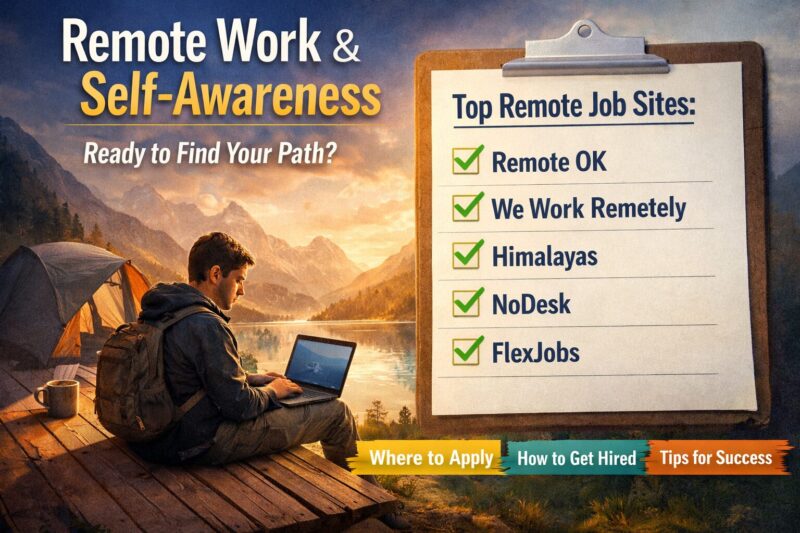
Where to Find Remote Work (And How to Use It Properly)
Most people approach remote job hunting the same way they approach traditional jobs:
- Apply everywhere
- Use the same resume
- Hope something works
And then assume it’s “too competitive” when it doesn’t.
That approach rarely works.
Because remote platforms are not all the same.
They fall into three distinct categories:
1. Aggregators (High Volume, High Competition)
These platforms pull listings from across the internet.
Remote OK
Overview
A large, fast-moving aggregator with thousands of listings.
What It Offers
- Massive job volume
- Salary and benefits tags
- Global opportunities
Who It’s For
- Beginners to advanced
- Especially useful for tech and digital roles
Pros
- High volume
- Frequent new postings
Cons
- High competition
- Jobs fill quickly
Reputation
Widely used, but known for speed-based competition.
Best Use Strategy
Apply within hours of posting. Treat it like a timing game—not a browsing platform.
2. Curated Job Boards (Quality Over Quantity)
These platforms manually review listings.
We Work Remotely (WWR)
Overview
One of the most respected curated remote job boards.
What It Offers
- High-quality companies
- Clean, focused listings
Who It’s For
- Intermediate to advanced
- Especially strong for tech, design, and marketing
Pros
- Less noise
- Better companies
Cons
- Fewer listings
Reputation
Very strong trust and consistency.
Best Use Strategy
Customize every application. You’re competing on quality, not speed.
NoDesk
Overview
A smaller curated board with strong educational content.
What It Offers
- Clean job listings
- Remote work insights
Who It’s For
- Beginners exploring remote work
Pros
- Simple and focused
- Great learning resources
Cons
- Limited listings
Reputation
Trusted but niche.
Best Use Strategy
Use alongside another platform—not as your main source.
Remote.co
Overview
Curated jobs with strong beginner guidance.
Best Use Strategy
Ideal entry point for understanding remote work expectations.
Working Nomads
Overview
Email-based curated listings across industries.
Best Use Strategy
Use passively—let opportunities come to you.
FlexJobs
Overview
Paid platform with vetted listings.
Pros
- Scam-free
- High trust
Cons
- Subscription cost
Best Use Strategy
Best for those overwhelmed by low-quality listings elsewhere.
3. Smart Platforms (Precision + Tools)
These platforms go beyond listings.
Himalayas
Overview
A modern remote platform with advanced filters and AI tools.
What It Offers
- Timezone filtering
- Salary transparency
- Resume and interview tools
Who It’s For
- Serious job seekers
- Tech and remote-first roles
Pros
- High precision
- Strong UX
Cons
- Requires setup effort
Reputation
Growing quickly with strong user feedback.
Best Use Strategy
Optimize your profile fully. Treat it like a portfolio, not just a resume.
Built In
Overview
Tech and startup-focused job board.
Best Use Strategy
Use if you’re specifically targeting SaaS or startup environments.
The Strategy Most People Miss
The biggest mistake:
Trying to use every platform at once.
Better approach:
- Pick 1–2 platforms
- Learn how they work
- Apply intentionally
Recommended Combination
- Remote OK → volume
- Himalayas → precision
- WWR → quality
Why this works:
- You get exposure (Remote OK)
- You get alignment (Himalayas)
- You get credibility opportunities (WWR)
It’s not about doing more.
It’s about removing noise.
Stepping Into the Unknown
Even with the right tools, there’s still a deeper hesitation.
Not about skills.
Not about opportunity.
About uncertainty.
Remote work doesn’t guarantee stability.
It doesn’t promise clarity.
It doesn’t tell you exactly what happens next.
And that’s the point.
As explored in the podcast:
“You can just let go and be yourself. You don’t have to be afraid.”
That doesn’t mean everything becomes easy.
It means the fear of not knowing doesn’t have to stop you.
This Isn’t About Escaping Work
It’s not about avoiding structure.
Or chasing comfort.
Or building a “perfect lifestyle.”
It’s about recognizing something simpler:
That the space you’ve been looking for
isn’t something you earn.
It’s something that becomes visible
when you stop filling every moment.
Remote work just happens to create the conditions for that.
Not because it changes who you are.
But because it gives you the room to notice
that you were never as fixed as you thought.
And if you’re willing to explore that—not control it, not define it, but actually experience it—
then this isn’t just a career shift.
It’s the beginning of a very different kind of understanding.
Further Exploration
This recognition—of identity, uncertainty, and the freedom beneath both—is explored more deeply in Proof That You’re God.