
At some point, many people who resonate with non-dual understanding run into a quiet confusion.
You’ve seen through the idea of a separate self — at least enough to know it’s not what it once seemed. You understand, conceptually and experientially, that identity is constructed, fluid, not as solid as it appears.
And yet.
Love still hurts.
Intimacy still destabilizes.
Connection still feels complicated, demanding, or oddly threatening.
This can be disorienting in a particular way. Not dramatic — just subtle enough to make you wonder whether you’ve misunderstood something fundamental.
If there’s no separate self, why does this still feel so personal?
“If there’s no self, why does intimacy feel so threatening?”
This is often the first question that arises, even if it’s never stated out loud.
Because the absence of a solid self doesn’t mean the absence of self-maintenance.
Identity doesn’t disappear just because it’s seen through. It continues as a set of habits — patterns of orientation, emotional reflexes, subtle ways of keeping experience predictable.
Intimacy disrupts those patterns.
Not aggressively. Often quietly. You relax. You open. You stop bracing. And in that softening, the usual reference points that make experience feel navigable begin to loosen.
The threat isn’t coming from the other person.
It’s coming from the interruption of the mechanisms that quietly say, “This is me, and this is where I stand.”
Non-dual understanding doesn’t eliminate those mechanisms — it simply makes them visible when they start to falter.
“Why does love feel like I’m disappearing?”
This question carries a lot of fear, especially for people who’ve done deep inquiry.
If the self is already seen as illusory, then the feeling of disappearing can feel like something is going too far — like there’s nothing left to orient from.
But what’s disappearing isn’t you.
What’s fading is the effort required to maintain continuity.
Much of what feels like “me” is actually a low-level activity: narrating, positioning, monitoring, defining. Love — especially mutual, uncomplicated love — reduces the need for that activity.
And when the activity slows down, the mind interprets the absence of effort as absence of self.
This is why love can feel more destabilizing than pain. Pain sharpens identity. Love doesn’t need it.
“If nothing is wrong, why do I suddenly want space?”
This question often brings shame with it.
Everything is fine. The relationship is healthy. The connection is real. And yet, there’s a growing desire to pull back — not dramatically, just enough to breathe.
This is usually framed as avoidance or fear of intimacy. But from a non-dual lens, something subtler is happening.
Space reintroduces edges.
It brings back contrast, autonomy, orientation. It gives identity something to push against again.
The desire for space isn’t always about escaping closeness. Sometimes it’s about restoring a familiar sense of selfhood that closeness has gently dissolved.
That doesn’t make the desire wrong — but it does change how it’s understood.
Instead of diagnosing the impulse, it can simply be noticed as the system rebalancing itself.
This dynamic — where relationships quietly expose the structures we rely on to feel real — shows up repeatedly in how connection becomes the stage for inner tension, a pattern explored more broadly in why relationships so often feel hard even when they’re working.
“Am I avoiding intimacy, or is intimacy revealing something?”
This question is where self-trust often wavers.
Because once non-dual insight is present, the usual psychological explanations don’t land the same way. You can no longer fully believe the story that something is wrong with you — but the discomfort is still there.
Intimacy doesn’t create the discomfort.
It removes the distractions that usually keep it in the background.
When someone is close, there’s less room to manage experience through busyness, self-focus, or emotional distance. What remains isn’t a flaw — it’s unfiltered awareness encountering itself without its usual buffers.
The urge to step back can be avoidance.
Or it can be honesty.
The difference isn’t found by analyzing the impulse, but by noticing whether the movement is driven by fear — or by a quiet recognition that something is being seen more clearly than before.
“Why does love feel less like ‘me’ and more… unclear?”
For many people drawn to non-duality, clarity becomes a subtle identity.
Understanding. Insight. Seeing through illusion.
Love doesn’t always support that identity.
It doesn’t arrive as clarity — it arrives as immediacy. Sensation. Vulnerability. Presence without explanation.
This can feel strangely impersonal, even while being deeply intimate.
Less like “I am loving”
More like “This is happening”
The mind often reacts to that with discomfort, because it doesn’t know how to claim the experience as mine.
But love isn’t asking to be claimed.
It’s inviting experience without ownership.
And that can feel unsettling until it’s allowed to remain that way.
Love Isn’t Failing — Identity Is Just Relaxing
None of these questions mean you’re doing intimacy wrong.
They mean that love is touching the same place inquiry touches — but without language, structure, or conceptual safety nets.
Non-dual understanding doesn’t make relationships simple.
It makes them revealing.
Love doesn’t challenge the idea of a separate self by arguing against it.
It challenges it by making the argument unnecessary.
What feels destabilizing is often the absence of effort — not the loss of self.
And that absence can feel terrifying right up until it feels like relief.
Final Reflection
If non-duality has shown you that the self is less solid than it once appeared, intimacy may be where that insight stops being theoretical.
Love doesn’t ask you to disappear.
It asks you to stop holding yourself together.
And the questions that arise there aren’t problems to solve — they’re invitations to notice what no longer needs defending.
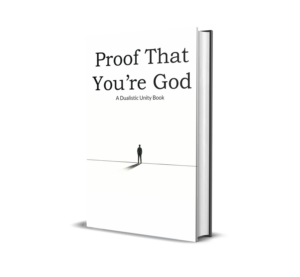
Proof That You’re God explores this same tension across love, anxiety, meaning, and control — not by offering answers, but by tracing how identity relaxes when it’s no longer required. If this article resonates, the book continues that inquiry with the same grounded, lived honesty.
Nothing is wrong with love.
It’s just more honest than the self expects.