
What if uncertainty isn’t a problem to solve—but one of the very conditions that makes life possible?
Few experiences are as uncomfortable as not knowing.
We want to know whether the relationship will last, whether we’ll get the job, whether our health will improve, whether our children will be okay, whether we’ve made the right decision, and whether everything will eventually work out. When certainty feels unavailable, it’s easy to believe something has gone wrong. We search for more information, ask more people for advice, replay conversations, imagine different futures, and tell ourselves that if we can just think a little longer, we’ll eventually arrive at an answer that removes all doubt.
Yet the longer we chase certainty, the more elusive it often becomes.
Before asking how to deal with uncertainty, perhaps it’s worth asking a different question.
What if uncertainty was never the problem?
We Spend Much of Our Lives Negotiating with the Unknown
From the moment we’re born, uncertainty becomes part of every meaningful experience. No one knows what kind of parent they’ll become before their first child arrives. No one knows how a new relationship will unfold, whether a business will succeed, or where a difficult conversation might lead. Every meaningful chapter of life begins before we know how it ends.
Despite this, many of us quietly believe certainty should arrive before participation. We wait until we feel completely ready, completely confident, or completely sure before taking the next step. The difficulty is that life has never worked that way. Understanding almost always follows experience rather than preceding it.
Looking back, many of the moments that shaped your life probably seem inevitable.
Living through them rarely felt that way.
Why the Mind Craves Certainty
The human mind is extraordinary. It recognizes patterns, remembers experiences, imagines possibilities, and anticipates outcomes. These abilities help us navigate an incredibly complex world, allowing us to learn from yesterday while preparing for tomorrow.
The challenge begins when we expect those same abilities to eliminate uncertainty altogether.
We ask thought to guarantee the future. We ask planning to prevent every mistake. We ask certainty to protect us from disappointment, rejection, grief, and loss. None of those are failures of the mind. They’re simply impossible requests because life continues changing whether we’re prepared for it or not.
The mind isn’t malfunctioning.
It’s simply being asked to do something no mind can do.
Every Strategy We’ve Explored Leads Here
If you’ve been reading the articles leading up to this one, you may have noticed a common thread running through all of them. At first glance they seem to explore very different struggles—approval, comparison, overthinking, anxiety, worry, fear of change—but each one points toward the same underlying question.
When we seek approval, we’re often hoping someone else can make us feel certain about ourselves. When we compare ourselves to others, we’re trying to determine whether we’re on the right path. Overthinking becomes an attempt to imagine every possible outcome before acting, while worry rehearses uncertain futures in the hope that preparation might somehow become protection. Even our fear of change often reflects a desire to preserve the certainty we’ve built our identity around.
Although these experiences appear different on the surface, they all arise from the same assumption: that if we could become certain enough, we’d finally be able to relax.
The Illusion of Arrival
Imagine finally achieving something you’ve wanted for years. You receive the promotion, your business becomes successful, you find a loving relationship, or you reach a financial goal that once seemed impossible. For a brief moment, everything feels settled, as though you’ve finally arrived at the place you’ve been working toward.
Then life continues.
New responsibilities appear. New expectations emerge. New uncertainties quietly replace the old ones, and what once felt like the finish line becomes the starting point for another chapter. The relationship deepens and introduces new challenges. Success creates new opportunities as well as new risks. Every answer naturally gives rise to another question.
This isn’t evidence that you’ve failed to find certainty. It’s evidence that certainty was never designed to last. Life continues unfolding, and every new beginning brings questions that couldn’t have existed before.
Uncertainty Is What Makes Life Alive
Imagine if every chapter of your life had been written before you lived it. Every friendship, every conversation, every challenge, every success, and every loss would already be known. There would be no surprises, no difficult decisions, and no unanswered questions waiting around the next corner.
Would there still be curiosity? Would love feel as meaningful if you already knew exactly how every relationship would unfold? Would courage have any significance if there were never any risk?
The experiences we treasure most derive much of their meaning from uncertainty itself. Love requires the possibility of loss. Creativity depends on not knowing exactly what will emerge. Discovery is only possible because something remains unknown, and even hope exists because the future has not yet been written.
Without uncertainty, life might become predictable.
It would also lose much of what makes it feel alive.
Participation Instead of Prediction
Many of us have spent years trying to predict life well enough that we’ll never have to feel vulnerable. We imagine that if we can gather enough information, anticipate enough possibilities, or make enough perfect decisions, we’ll eventually earn the right to relax.
But perhaps vulnerability isn’t evidence that we’re failing.
Perhaps it’s evidence that we’re fully participating.
Participation doesn’t require certainty. It requires presence. Instead of asking, “How can I know exactly what will happen?” we begin asking, “What is the next honest step available to me?”
That question doesn’t eliminate uncertainty.
It brings us back to where life is actually unfolding.
Trust Is Different from Certainty
People often use the words trust and certainty as though they mean the same thing, but they’re describing two very different experiences. Certainty says, “I know exactly how this will end.” Trust says, “I don’t know how this will end, but I believe I can meet whatever unfolds with honesty, curiosity, and the willingness to learn.”
Trust doesn’t eliminate uncertainty, nor does it require us to predict the future. Instead, it grows through experience. Every challenge you’ve already survived, every mistake you’ve learned from, and every unexpected turn you’ve adapted to has quietly strengthened your capacity to respond to whatever comes next.
Perhaps that’s why certainty always feels temporary while trust can continue growing throughout a lifetime.
Perhaps what we’re really searching for has never been certainty at all.
It has been trust.
Questions Worth Sitting With
The next time uncertainty feels overwhelming, pause for a moment and ask yourself:
- What certainty am I hoping to find?
- What do I believe certainty would protect me from?
- Am I trying to understand this situation, or control its outcome?
- What is the next honest step available to me?
- What becomes possible when I stop demanding guarantees before participating?
These aren’t questions designed to eliminate uncertainty.
They’re invitations to discover a different relationship with it.
Final Thoughts
Perhaps we’ve misunderstood uncertainty for most of our lives.
We’ve treated it as an obstacle standing between us and peace, something to overcome before we can finally relax and begin living. Yet uncertainty has been present in every meaningful chapter we’ve ever experienced. It was there when we learned to walk, when we fell in love, when we grieved, when we forgave, when we created, and every time we stepped into something that mattered without knowing exactly where it would lead.
Life has never asked us to become certain before participating.
It has only invited us to participate before understanding.
Perhaps peace doesn’t arrive when uncertainty disappears. Perhaps peace begins when we stop asking life to become something it has never been.
Not predictable.
Not controllable.
But beautifully, endlessly alive.
Continue the Exploration
If this article resonated with you, it’s likely because uncertainty isn’t just an abstract idea—it’s something you’ve experienced in countless forms throughout your life.
For many of us, the struggle has never been uncertainty itself. It’s been the belief that peace depends on finally escaping it. We search for certainty through achievement, approval, control, identity, knowledge, and even spirituality, hoping that one more answer will finally allow us to relax. Yet every answer eventually gives way to another question because life never stops unfolding.
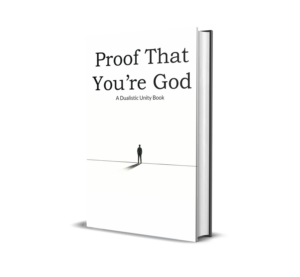
Proof That You’re God begins where that realization leaves off.
Rather than offering another philosophy to believe or another method for controlling your experience, the book explores a more fundamental shift in perspective. The goal isn’t to become fearless. It isn’t to eliminate uncertainty or discover permanent answers. It’s to develop a relationship with life that no longer depends on certainty before you’re willing to participate in it.