
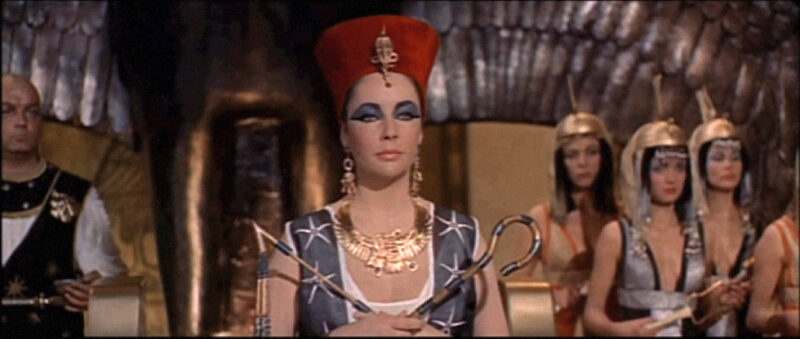
Few phrases appear in debates about casting as often as “historical accuracy.” Whenever a Black actor is cast as a historical or mythological figure traditionally portrayed as white, the discussion quickly turns to authenticity. Recent reactions to Lupita Nyong’o’s casting as Helen of Troy in Christopher Nolan’s The Odyssey are only the latest example. Critics argued that Helen should be portrayed by a white actress because ancient Greek mythology describes her as “white-armed” and because the story belongs to a particular historical and cultural tradition.
Historical accuracy is a perfectly reasonable concern.
The interesting question is whether Hollywood has applied that standard consistently.
Looking back across the history of American cinema, the answer appears to be no.
A Long History of Whitewashing
The entertainment industry even has a term for the practice of casting white actors to portray non-white characters: whitewashing. It has occurred often enough that film historians, media scholars, and journalists have documented it for decades.
It is impossible to produce a definitive count because the definition varies. Some researchers include only explicitly historical figures, while others include fictional characters whose ethnicity is central to the story. Depending on the criteria, published lists identify dozens to well over one hundred major examples throughout Hollywood history.
A few of the most well-known include:
- Elizabeth Taylor as Cleopatra (Cleopatra, 1963)
- John Wayne as Genghis Khan (The Conqueror, 1956)
- Mickey Rooney as the Japanese landlord Mr. Yunioshi (Breakfast at Tiffany’s, 1961)
- Charlton Heston as Moses (The Ten Commandments, 1956)
- Christian Bale as Moses and Joel Edgerton as Ramses II (Exodus: Gods and Kings, 2014)
- Jake Gyllenhaal as Dastan (Prince of Persia: The Sands of Time, 2010)
- Scarlett Johansson as Motoko Kusanagi (Ghost in the Shell, 2017)
- Tilda Swinton as the Ancient One (Doctor Strange, 2016)
- Emma Stone portraying a character of part Asian and Native Hawaiian ancestry (Aloha, 2015)
These examples span nearly seventy years.
Yet relatively few generated widespread calls for strict historical accuracy before modern conversations about diversity became more prominent.
Cleopatra Was Not English
Elizabeth Taylor’s Cleopatra remains one of the most famous examples.
To be clear, Cleopatra VII was not ethnically Egyptian in the modern sense. She belonged to the Ptolemaic dynasty, descendants of one of Alexander the Great’s Macedonian Greek generals. Most historians conclude that her paternal ancestry was overwhelmingly Macedonian Greek, while uncertainty remains about the identity of her mother and maternal grandmother. There is no scholarly consensus that Cleopatra was Black, despite claims sometimes made in popular culture.
That uncertainty matters.
Because the historical debate was never whether Cleopatra was English.
Or American.
Or a blue-eyed Hollywood movie star.
Taylor’s casting reflected a broader tradition of presenting the ancient Mediterranean through a predominantly white, Western lens.
The discussion at the time focused far more on whether she was glamorous enough than whether she accurately represented the complexities of Hellenistic Egypt.
Spartacus Is More Complicated Than Popular Memory
Another figure often mentioned in these conversations is Spartacus.
The historical Spartacus was a Thracian gladiator who led the great slave revolt against Rome between 73 and 71 BCE. Ancient Roman sources consistently identify him as Thracian, a people from southeastern Europe, not sub-Saharan Africa. There is no verified historical evidence that Spartacus was Black, despite occasional claims circulating online.
That does not mean Hollywood has always portrayed antiquity accurately.
Far from it.
Ancient Rome was ethnically diverse. Its empire stretched across Europe, North Africa, and the Middle East. Soldiers, merchants, diplomats, enslaved people, and political leaders came from many regions. Yet twentieth-century Hollywood frequently depicted the ancient Mediterranean as almost exclusively white.
The issue, then, is not that Spartacus himself was Black.
It is that entire civilizations were often simplified into a narrow visual ideal.
Accuracy Has Always Been Flexible
Consider this.
Hollywood routinely changes historical details for dramatic purposes.
Characters are invented.
Timelines are compressed.
Battles happen differently.
Dialogue is modernized.
Relationships are rewritten.
Entire endings are changed.
Few audiences object when these creative liberties improve the pacing or emotional impact of a story.
The difficulty begins when race appears to become the one element some viewers insist must remain untouched.
That inconsistency raises an important question.
Is the concern truly historical accuracy?
Or is it that certain casting choices feel unfamiliar because audiences have inherited expectations about who naturally belongs in particular stories?
Mythology Is Not a Documentary
The controversy surrounding The Odyssey illustrates this tension particularly well.
Helen of Troy is a mythological figure rather than a documented historical person. Homer describes her with poetic language, but the Odyssey also includes gods, monsters, witches, cyclopes, shape-shifters, prophetic visions, and magical interventions. Like many myths, it has been reinterpreted repeatedly across more than two thousand years through paintings, plays, operas, novels, television, and film.
Christopher Nolan’s adaptation has already taken numerous artistic liberties beyond casting, as every major adaptation of classical mythology has done. Yet much of the public debate has focused almost exclusively on the race of one performer.
Notice what happens when historical accuracy becomes highly selective.
Creative freedom is celebrated in dozens of areas.
Race becomes the exception.
Whose Perspective Feels “Normal”?
One possibility is that these debates reveal less about ancient history than about modern assumptions.
For generations, Hollywood presented white actors as the universal default. They played Romans, Egyptians, Persians, Native Americans, Polynesians, Asians, biblical figures, and countless fictional heroes. Entire worlds—from fantasy kingdoms to ancient civilizations—were imagined primarily through a European visual lens.
Because audiences saw this repeatedly, it came to feel natural.
When casting begins to challenge that expectation, some viewers experience it as political rather than simply different.
What often goes unnoticed is that the earlier tradition was political too.
It reflected who held power in the film industry, who was considered bankable, and whose stories were treated as universal.
The difference is that one perspective had decades to become invisible.
Loving Movies While Seeing Their Patterns
Recognizing these patterns does not require rejecting classic films.
Many beloved movies remain extraordinary achievements despite their limitations.
Lawrence of Arabia is still remarkable.
The Ten Commandments remains influential.
Cleopatra remains iconic.
The Lord of the Rings remains one of the greatest fantasy trilogies ever made.
Appreciating these works does not prevent us from asking thoughtful questions about whose perspectives they centered and whose they overlooked.
In fact, doing both may deepen our appreciation of cinema rather than diminish it.
Stories are never created in isolation.
They reflect the assumptions of the cultures that produce them.
Looking Beyond the Argument
Debates about historical accuracy often become emotionally charged because they touch something deeper than casting. They ask who gets to represent the past, who gets to imagine the future, and whose face we instinctively associate with heroism, beauty, wisdom, or power. These are not simply questions about movies. They are questions about perception itself.
The more carefully we examine the stories we inherit, the more clearly we begin to see the lenses through which we have learned to view the world. That awareness is not about condemning the past. It is about recognizing that every culture tells stories from somewhere, and every generation has the opportunity to look again.
If these questions about identity, perception, culture, and the assumptions that quietly shape our thinking resonate with you, consider reading Proof That You’re God. The book explores how the mind constructs identity, certainty, and meaning, inviting readers to examine not only the stories told around them, but also the stories they have been telling themselves all along.