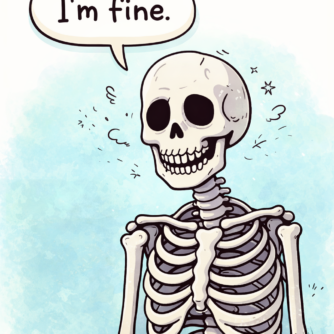

There’s a kind of anxiety that doesn’t make sense.
Nothing is wrong.
Nothing is urgent.
Nothing is about to fall apart.
And yet, there it is.
A tightness in the chest.
A restless scanning of the mind.
A subtle feeling that something is off — even though you can’t point to anything that actually is.
This form of anxiety is especially confusing because it appears in the absence of a problem. There’s no clear trigger to manage, no obvious threat to address, no narrative that explains why your body is suddenly on edge.
Which often leads to a second layer of anxiety:
“Why am I anxious when everything is fine?”
That question alone can keep the loop going.
This experience fits into a broader pattern we explore in why anxiety isn’t about what’s happening — how anxiety often has less to do with circumstances and more to do with the way the nervous system has learned to relate to uncertainty.
But this particular flavor of anxiety has its own texture, and it’s worth looking at closely.
When Anxiety Isn’t Reactive — It’s Anticipatory
Most people assume anxiety is a reaction to danger.
Something happens.
The body responds.
But the anxiety that shows up when nothing is wrong isn’t reactive.
It’s anticipatory.
The system isn’t responding to a threat.
It’s waiting for one.
This can feel like:
- A sense of bracing for impact
- Difficulty relaxing into calm moments
- Restlessness during downtime
- A vague sense that something needs attention, even though nothing does
The nervous system has learned that calm is temporary — and that it’s safer to stay alert than to be surprised.
Why Calm Can Feel Unsafe
For many people, calm is unfamiliar.
Not because their lives are chaotic in obvious ways, but because their internal environment has been conditioned around constant readiness.
If you’ve spent enough time:
- anticipating problems
- managing emotions
- staying “on top of things”
- monitoring outcomes
then calm doesn’t register as relief.
It registers as exposure.
When nothing is wrong, there’s nothing to manage — and that can feel more unsettling than having a clear issue to deal with.
The Anxiety of “Nothing to Fix”
This is where the experience often turns inward.
With no external problem to solve, the mind starts looking inside.
It asks:
- “Am I missing something?”
- “Did I forget something important?”
- “Is this a sign that something bad is coming?”
- “Why can’t I just enjoy this?”
The search for a cause becomes the cause.
Anxiety feeds on ambiguity, and “everything is fine” is surprisingly ambiguous when you’re used to vigilance.
When Anxiety Is a Habit, Not a Signal
This kind of anxiety is rarely a message.
It’s not trying to warn you.
It’s not pointing to a hidden danger.
It’s often just a pattern that hasn’t powered down yet.
The nervous system doesn’t instantly recalibrate when life becomes safer, steadier, or more stable.
It continues running old programs:
- scanning
- predicting
- preparing
Not because they’re needed — but because they’re familiar.
Why This Anxiety Feels So Personal
When anxiety shows up without a reason, it’s easy to turn it into a personal failing.
You might think:
- “I should be grateful.”
- “Other people have it worse.”
- “Why can’t I just relax?”
- “What’s wrong with me?”
But this anxiety isn’t about ingratitude or weakness.
It’s about conditioning.
A system that learned to stay alert doesn’t immediately trust that it can stand down.
The Role of Identity in Subtle Anxiety
There’s another layer here that’s easy to miss.
For many people, being “the one who handles things” becomes part of their identity.
When nothing is wrong:
- that role has no job
- the identity has no function
- the sense of purpose softens
Anxiety can arise not because something bad is happening — but because a familiar self has nothing to do.
This is similar to what happens when thinking becomes compulsive or when emotional numbness brings clarity. In each case, the system reacts not to danger, but to the absence of familiar activity.
Why Reassurance Doesn’t Work
When you try to reassure yourself — “Everything is okay” — it rarely helps.
Because the anxiety isn’t caused by believing things are bad.
It’s caused by the body not knowing how to be when there’s nothing to manage.
Reassurance addresses thoughts.
This anxiety lives in patterned readiness.
That’s why it often fades on its own once something requires attention again — even if that something is mildly stressful.
Stress gives the system a job.
What Actually Softens This Kind of Anxiety
Not fixing it.
Not suppressing it.
Not analyzing it.
What helps is recognition.
Seeing that:
- this anxiety isn’t a warning
- it isn’t meaningful
- it isn’t personal
- it isn’t something you need to act on
It’s just momentum.
And momentum slows naturally when it’s no longer being interpreted as a problem.
Letting Anxiety Be Unemployed
This can sound counterintuitive, but the turning point often comes when you stop trying to use the anxiety for something.
No lesson to extract.
No action to take.
No story to complete.
Just noticing:
“Anxiety is here, even though there’s nothing wrong.”
That noticing removes the need to resolve it.
And without a task, anxiety often loosens on its own.
This Isn’t About Forcing Calm
It’s important to be clear:
This isn’t an instruction to relax.
Or to be present.
Or to appreciate the moment.
Those become new tasks.
This is about allowing the nervous system to experience neutrality without immediately interpreting it as danger.
That takes time — not effort.
A Quiet Shift
Over time, something subtle can change.
Moments of “nothing wrong” start to feel less exposed.
Calm becomes less suspicious.
Anxiety appears less often — and when it does, it’s less convincing.
Not because you fixed yourself.
But because the system learned, gradually, that it doesn’t need to stay on guard all the time.
Nothing Is Being Asked of You
If you recognize this experience, there’s nothing you need to do differently.
No habit to adopt.
No belief to replace.
No state to maintain.
Just notice when anxiety shows up without a reason — and let that be what it is.
Sometimes, that’s enough to remind the body that the absence of danger doesn’t require a response.
A Closing Without a Conclusion
Anxiety that appears when nothing is wrong isn’t a sign that something is wrong.
It’s often a sign that vigilance has outlived its usefulness.
And seeing that — without trying to change it — is often what allows it to finally rest.
If this resonates, Proof That You’re God explores this same pattern across anxiety, control, and identity — how relief often arrives not through effort, but through understanding the structures we’ve been unconsciously maintaining.
Nothing needs to be solved.
What’s seen no longer has to keep signaling.