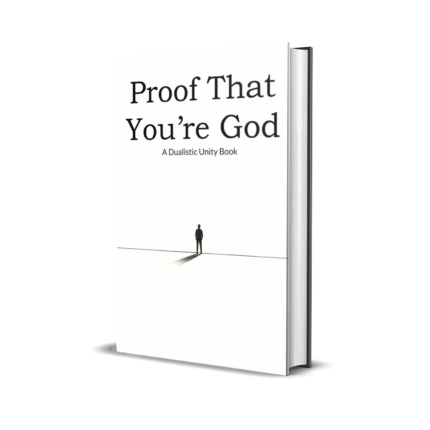
Proof That You’re God exists for a specific moment—one many people reach quietly, without language for it.
It’s the moment when familiar explanations about life, meaning, identity, or control stop working…
but nothing rushes in to replace them.
You’re not confused.
You’re not broken.
And you’re not looking for new beliefs.
You’re trying to figure out how to live after certainty loosens.
This book exists for that.
Why This Book Exists
Most books promise answers.
This one doesn’t.
Proof That You’re God wasn’t written to explain reality, argue a worldview, or convince you of anything. It was written because many people reach a point where:
- old identities feel artificial
- meaning feels thinner but more honest
- control feels unnecessary and exhausting
- spirituality feels too certain
- skepticism feels too shallow
And what’s missing isn’t information.
It’s containment.
This book exists to hold that space—to explore what happens when questioning isn’t rushed toward replacement.
What This Book Is (and Isn’t)
This book is:
- experiential, not theoretical
- grounded, not mystical
- personal, not prescriptive
- exploratory, not conclusive
It isn’t:
- a spiritual system
- a philosophical argument
- a self-improvement guide
- a set of practices or steps
- a promise of awakening
If you’re looking for something to believe, adopt, or follow, this book will likely disappoint you.
If you’re looking for something to sit with, it may feel familiar very quickly.
Who This Book Is For
This book is for people who have already begun to see through things—and don’t know what to do with that clarity.
You may resonate if:
- you’ve questioned meaning without becoming nihilistic
- you’ve lost interest in certainty but not in honesty
- you’ve noticed control relaxing on its own
- you feel less driven by fear, but also less anchored by identity
- you’ve wondered whether clarity is supposed to feel this destabilizing
Many readers describe a sense of recognition rather than learning.
Not “I never thought of that,”
but “Yes… that’s what’s been happening.”
Why a Book (When the Site Exists)
The articles on DualisticUnity.com are designed to be entry points.
They meet people where they are.
They name experiences that often go unnamed.
They open doors.
But a website is fragmented by nature.
You read one piece.
Then another.
Then something else pulls your attention away.
The book exists because some experiences don’t unfold well in fragments.
A book:
- slows the pace
- creates continuity
- allows ideas to deepen without interruption
- offers privacy and coherence
Many readers don’t want more content.
They want one place to stay.
The Core Exploration
At its heart, Proof That You’re God explores a simple but unsettling territory:
What happens when the sense of being a separate self loosens—not as a belief, but as lived experience?
The book looks at:
- identity without pathology
- emotion without resistance
- control without necessity
- death without “after”
- meaning without guarantees
- awareness without hierarchy
Not as conclusions, but as observations.
The book doesn’t try to resolve paradox.
It stays with it.
This approach aligns closely with our broader exploration of identity and the narratives we use to hold ourselves together—especially when those narratives begin to soften on their own.
👉 https://dualisticunity.com/the-self-youre-trying-to-hold-together/
How This Book Is Written
The tone is intentional.
This book does not try to:
- persuade
- impress
- overwhelm
- destabilize for effect
It was written slowly, from lived inquiry rather than theory.
Many readers report reading it:
- in short sections
- more than once
- not always linearly
That’s expected.
This isn’t a book to “get through.”
It’s a book to return to.
What Readers Are Saying
Readers rarely describe Proof That You’re God as a book that gives answers. They describe it as a book that changes how questions are held.
“This book caught me off guard. It isn’t about giving you answers—it’s about challenging everything you think you know about yourself. It’s raw, eye-opening, and surprisingly relatable.”
— ★★★★★ Verified Reader (United States)
“What hit me hardest was how it reframes uncertainty. Instead of fearing it, this book helped me see it as where life really happens.”
— ★★★★★ Verified Reader (United States)
Many readers note that the book feels grounding rather than escapist—especially compared to more traditional spiritual writing.
“I found the book incredibly grounding, leading me more into this human experience rather than away from it. That’s rare for books in this space.”
— ★★★★★ Verified Reader (United Kingdom)
Others appreciate its accessibility and lack of intellectual gatekeeping.
“Never has there been a read with such a logical and simple approach to this subject matter. You don’t feel like you need to earn the understanding.”
— ★★★★★ Verified Reader (United Kingdom)
Several readers describe opening the book to any page and finding something that speaks directly to their current experience.
“It’s like a fortune cookie—but one that somehow applies exactly to what I’m going through.”
— ★★★★★ Verified Reader (Canada)
A Note on Criticism
Not every reader resonates with this approach.
Some reviewers expected clearer explanations, tighter arguments, or more traditional philosophical structure—and found the book frustrating, incoherent, or unsatisfying.
That response is understandable.
This book does not aim to explain reality or provide conclusions. It does not build a system or resolve uncertainty through explanation. Instead, it stays with ambiguity and examines what it’s like to live without replacing it.
For readers looking for definitive answers, frameworks, or reassurance through explanation, this book may not be a good fit.
For readers who feel that certainty has already begun to loosen, the experience is often very different.
What This Book Won’t Do
It won’t tell you:
- who you really are
- what you should believe
- how to live your life
- what comes next
It won’t rescue you from uncertainty.
What it can do is something quieter:
Help you stop treating uncertainty as a problem.
Why People Choose to Read It
Readers often choose this book not because they’re searching…
…but because something already fell away.
Certainty loosened.
Fear softened.
Old motivations stopped making sense.
And instead of rushing to replace them, this book offers companionship in that space.
Not answers.
Not direction.
Just clarity without demand.
If You’re Considering It
You don’t need this book.
Nothing is missing.
But if the articles here feel familiar—if they’ve named experiences you didn’t know how to describe—this book is where those explorations are allowed to unfold without interruption.
You can learn more about Proof That You’re God and decide for yourself whether it’s something you’d like to sit with.